These are the modifications I’m making to our current understanding
of physics to provide underpinnings for the technology of the Star Wars
galaxy. Other interesting articles include Physics and Star Wars. Warning:
serious handwaving is taking place below in hopes of creating something
self-consistent enough for an RPG; the point of this exercise is coming up
with sufficient details that people playing technomages can handwave back
at me about the things their character is doing on the fly, and to have a
good enough set of rules about how the technology works that I can predict
side effects (e.g. the ease of detection of repulsorlift craft).
Force Fields
These are an outgrowth of better understanding of quantum electrodynamics;
the popular-science explanation is that they consist of vigorous lying to the
Pauli
exclusion principle. Physically, they consist of large numbers of
electrons in a subtly patterned wave, and they usually emit a healthy
electrical zap when they fail. Much incoming energy is simply deflected,
while some is absorbed as heat that needs to be dissipated in some way. A
full-powered force field in atmosphere has a distinctive sparkle caused by
repelling the atoms of the air around it. The best attack against a force
field is another force field that can merge with the first one; if you can do
so without setting off alarms in the equipment maintaining the first field,
you can then do unkind things like hook it up to a grounding cable (if you
have a planet handy), shorting out that entire segment of the field for a few
seconds. (Planet-based fields never touch ground to avoid this problem, which
is why the Imperials had to send in ground forces against the base on Hoth in
The Empire Strikes Back.) Matching fields without
setting off alarms is a job for a highly trained specialist.
The easiest force field to create is the kind used as a door or prison
cell, where the emitters completely surround the field. High-powered ones can
repel matter with a very high momentum; low-powered ones, called
particle screens, will let a macroscopic
object through with a feeling like walking through a soap bubble, while
bouncing most molecule-sized impacts. These are often used as substitutes for
airlocks in civilian starships, though most freighters have at least one real
airlock for use in case of power failure. Since particle screens operate at
such low power levels, their sparkle is extremely dim and only visible to a
dark-adapted eye. Some luxury droids are equipped to project a bubble
that will deflect inclement weather, or block the transmission of sound;
some swoopbikes have particle screens to cut down wind chill and avoid
sucking in bugs.
The next step up is the repulsorlift;
since a push on a force field pushes its emitters, it is so named because it
pushes the vehicle away from the ground. A repulsorlift field is spongy,
mostly invisible (save for dust, rain, and snow around it), and can’t go much
further than the width of the vehicle (or several multiples of it, if designed
for that, as in the case of most hovering droids); repulsorlift craft that
build up speed can reconfigure the field’s shape so the entire vehicle becomes
a ground effect
vehicle and attain low altitudes, but they don’t truly fly like swoops;
you drive a speeder and pilot a swoop. The field spreads the weight of the
vehicle over the vehicle’s entire footprint, and won’t deflect any serious
weapons. Physicists are usually tired of explaining that repulsorlifts aren’t
antigravity, as that’s a completely different technology used in swoops and
starships (though swoops and starfighters usually have repulsorlift capability
as well), and only the most pedantic insist on correcting people who get the
two mixed up. Repulsorlifts are more expensive than wheels or legs on a
vehicle or droid, but are much lower-maintenance.
A deflector
shield is more challenging to create. They require
numerous synchronized emitters working together that creates a field
that can completely surround the emitters. The smallest ones
developed to date are on starfighters and grav tanks.
Deflector-style emitters can also create particle screens, and many
warships have these distributed throughout their volume with automatic
triggers to activate if there’s a sudden pressure drop or the fire
sensors go off.
Tuning a force field to scatter laser beams decreases the acuity of
your optical sensors, but protects you from lasers, which is why such
weapons are largely considered obsolete. At lower levels of power,
the same effect can be used to create privacy screens.
Force fields can also be used in atmospheric propulsion, using
moving fields to push air through a tube; this is called a
field thruster. They’re the most
efficient way to turn electrical energy into propulsion, but if you’re
already burning fuel of some sort, it’s better to just use an advanced
jet engine. And if you’re already using a fusion reactor, it’s
easiest to just use an ion drive.
Another offshoot is the traction
field, using the force field to develop a very high coefficient
of static friction with a nearby surface. Repulsorlift vehicles
can ripple their lift cushion to move slowly— speeders never have to
parallel park, as they can just move sideways— or dig into soft surfaces
to decelerate quickly. Hovertanks rely on these.
Traction fields can also be used on chemical workbenches, creating pools
for various reactants (including acids that might eat through normal vessels)
and then dynamically combining them. They are also used in expensive user
interfaces to create tangible buttons to push, their boundaries highlighted
through small holoprojectors.
Gravitonics
The essence of gravitonic technology is the manipulation
of gravitic knots, which are
subatomic-sized twists of spacetime that require the powerful
gradients of black holes (naked
singularities in particular; an ordinary black hole won’t do) to
manufacture. (This is perhaps a result of
developing loop quantum
gravity.) Due to conservation, knots that are formed from charged
matter retain an electrical charge, which allows them to be contained
and manipulated by electromagnetic fields. Their containment vessels
must always retain a charge, or the knots will simply fall through
ordinary matter. They slowly decay over time (with a half-life of
about a century in a storage tank and about a decade under normal
use), so a civilization cut off from a supply of them will gradually
lose the ability to manipulate gravity.
Antigravity makes it easy to
maintain a given altitude at negligible energy cost. An antigravity
plate consists of a flat plane containing tumbling knots that scatter
incoming gravitons back along their path; Newton’s Third Law is
satisfied with the force on the plate being distributed
throughout the mass generating the gravity in the first place. This
is only noticeable with extremely sensitive equipment, and it’s
perfectly safe to stand under a hovering Imperial Star Destroyer.
Standing on top of an AG plate shields you from the gravity coming
from the immediate column of matter under your feet, but not from the
vector sum coming from the rest of the planet minus that cylinder, so
you feel almost the same force. AG plates tend to vibrate with a
wavelength based on the dimensions of a vehicle, which is why you hear
high-pitched thrums from small devices and low-pitched ones from large
ships; these can be damped out for an extra price.
Starfighters have an additional gadget called an
etheric rudder
that allows them to redirect their momentum while within an existing gravity
field, making it possible to execute tight turns while in low orbit;
the ship’s original momentum radiates as gravity waves, and any
space battle is very noisy to grav sensors.
The lower the gravitational gradient, the less useful the rudder is.
Engineers call it an etheric keel-rudder assembly.
Grav plates are the
source of the artificial gravity inside starships and space stations; they
consist of panels of circulating knots that release and absorb gravitons.
They can also be used to cancel normal gravity on a planet, allowing people to
train for free fall without having to leave the planet, and providing a basis
for palanquins for visitors from low-gravity worlds; they’re called
sleeping plates when used to provide a
zero-gravity bed, with a computer adjusting the fields to keep a sleeper
floating in the middle of a space of warm air,
and float-jail when used to keep a prisoner
hovering out of reach of any walls. Grav plates need to be on ceiling and
floor to set up a simple graviton current in a spacecraft; they need to angle
up from the floor at the sides to create free fall on a planetary surface.
The net system, observed from outside, does not change weight.
Tractor beams
are fields of force, but they are not based on the same technology
popularly referred to as force fields. Rather, they are graviton
projectors, and they exert the same force on their mounts as they
do on the object they pull on.
Acceleration
compensators are similar to grav plates and tractor beams; they are
hooked up to both accelerometers and the ship’s drive and are used to
counteract the effects of acceleration on fragile passengers and cargo. Most
of them are designed to counteract the main drive, but they also help keep
people from being thrown around by impacts. In military vessels, they’re
powerful enough to help maintain structural integrity.
Hyperspace
cannons and, later, hyperdrive were invented
on Corellia, and the
corresponding physical phenomenon was called hyperspace there. Subspace radio was
invented on Duro and its
propagation medium was dubbed subspace. The underlying
phenomenon is the same: another aspect of physical reality where travel maps
to great distances in the our more familiar realm, dubbed realspace by the press,
despite protests from physicists, who refer to it as basis level. It
doesn’t help that hyperspace engineering is ahead of hyperspace
physics; hyperdrive was reverse engineered from Rakatan technology.
This continuum has a number of energy levels; the higher the energy level, the
broader the mapping to realspace, and a shorter journey it takes to translate
into the same distance when exiting to realspace. The cost of translating to
a given energy level is inversely proportional to the wavelength of the energy
being translated. Radio waves in the range of a meter or so can easily be
boosted up to levels so high that the signals propagate at many light-years
per second; matter, on the other hand, has drastically shorter
wavelengths and can only be practically boosted to the speeds associated
with hyperdrive. The only difference between subspace radio and hypercomm
is the energy levels used to send the signals. No one has yet worked out
how to create a device that allows listening to radio waves on higher
energy bands while traveling in lower ones, so ships in hyperspace are
cut off from communications.
The technical
commentaries are well done, though I’m establishing that
there is a reference frame provided by the galaxy itself; as
velocity relative to the nearby stars increases, the cost of accessing
hyperspace increases precipitously. Because of this reference frame,
ships leaving hyperspace have a similar velocity relative to their new
neighborhood as they did to the one they left. Ships and planets
moving at less than relativistic velocity can enjoy near-instantaneous
communication with anyone within several light years; wars have been
fought over subspace bandwidth allocation. If a star system is moving
at a noticeable rate relative to the surrounding neighborhood, it’s
necessary to drop out of hyperspace, spend some time in sublight to
get into its area of influence, and then jump back into hyperspace
to finish the trip there.
Activating a hyperdrive deep in a gravity well is a good way to make a
hyperdrive explode, and is not a terribly efficient way of delivering
damage.
Stardrives leave ion trails that can be tracked with sufficiently good
sensors. A starship entering or exiting hyperspace leaves distinctive
ionization patterns
called hyperdust.
The HoloNet does
not yet exist; there is a patchy subspace packet relay network.
Subspace radios suitable for light freighters have a range of
light-minutes to light-hours. Capital ships can carry ones with
ranges of tens and even hundreds of light-years, and the massive
Subspace Node 1 orbiting Coruscant can broadcast thousands of
light-years.
The safest way to travel in hyperspace is to follow a chain of
jump beacons, powerful computers that
track all known masses in the area, talk to their neighbors via
hyperwave, and provide navigation information to starships. Jump
beacons often serve as high-bandwidth information relays as well. Since
control of a jump beacon can make life very easy for pirates, beacons
on major trade routes are well-manned and well-defended stations. Jump
beacons are usually owned by banks or mercantile consortia and charge
a modest fee, with a discount for uploading sensor log data after a jump
to provide feedback.
I’m going to meddle with canon a bit to reduce some of the more
absurd levels of energy expenditure documented in the Star Wars Technical
Commentaries on Power Technologies: Base Delta
Zero is just destruction of surface structures by capital ship
weapons, while turning
a planet’s surface to lava— originally developed as a
containment measure for civilizations developing self-replicating
molecular technology— is actually accomplished with large
mirrors that focus huge amounts of sunlight from a nearby star onto
the planet’s surface. Starship accelerations in the movies are
exaggerated for cinematic effect; 10g is a reasonable limit,
and I’ll just ignore that the Millennium
Falcon (2) is
supposed to be able to pull 3000g without being able to outrun
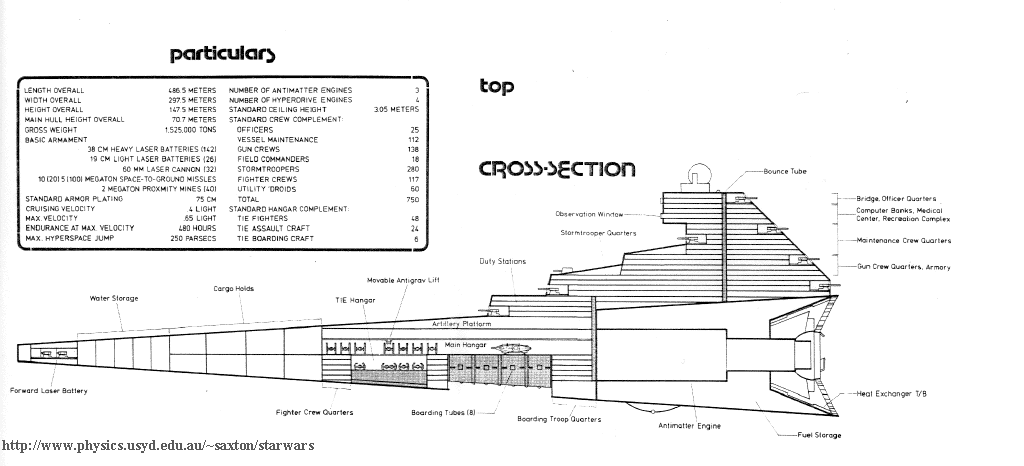
a star destroyer. The blueprints for a Star
Destroyer give mass at 1.525×10⁹ kg, so
P = m×(10g)×c =
4.5×10¹⁹ W, which is about six orders of magnitude
smaller than the estimates you get taking the accelerations from the
movies and only requires the annihilation of 500 kilograms of
matter per second. The blueprints suggest that they’re using
antimatter for power, but that is inconsistent with the destruction we
see in the films (as dying star destroyers don’t go up in a
blue-white flash that washes out the view for everyone present).
Tibanna is a
prime element that has
an extremely low threshold for nuclear fusion, particularly when
all of its nuclear spins are aligned. Mixing small amounts with
ordinary hydrogen can lower the threshold for a fusion reaction; in
high proportions, it can trigger fusion even in a blaster pistol.
The standard power plant for anything from a capital ship to a
continent is a large gravitational fusion installation. Ordinary
protium (hydrogen with no neutrons) is fed into a containment chamber
that is lined with a force field, and numerous graviton projectors
fire carefully tuned beams that constructively interfere at the center
of the reactor. This creates the density necessary to run proton-proton
fusion, just like in the hearts of stars. The gravitational
gradient keeps most of the plasma from even touching the force field,
and the force field only lets light out. The walls of the chamber are
lined with free-electron photovoltaic cells (basically a specialized
form of programmable
matter acting like a free electron
laser in reverse) that can capture even gamma rays and convert
them to useful electrical power.
Fightercraft, light freighters, and small space stations use smaller
gravitational fusion plants that require deuterium, 3He fuel, and a
bit of tibanna, with a highly explosive primer fuel that helps
start and sustain the reaction. (The massive terraforming station above Telos
in KOTOR 2 was staying up on antigravity rather
than being in a proper orbit, so it needed to minimize the supporting mass
that was handling those huge force fields, necessitating deliveries of such
primer fuel from Peragus II.)
Liquid-metal lithium tibannide is a dense but volatile fuel that can used
in place of ordinary tibanna in some fusion plants.
I wanted to get the liquid metal fuel thing from the YT-1300
in there.
Man-portable fusion
furnaces use bubble fusion,
and are commonly used to provide electrical power and heat for
extended field activity. Smaller, more expensive systems run on
tibanna.
Smaller vehicles like swoops use fusion furnaces, hydrogen fuel cells,
converting hydrogen and oxygen into water, or batteries; some
burn synthetic organic fuels, which still have rather good
energy density.
Fusion plants of all kinds put out lots of neutrinos. The only
way to mask this is to hide in the flux coming from a nearby star;
starships that need to go into stealth mode generally switch to fuel
cell power.
The most extremely energy-intensive applications use hypermatter,
which is an exotic form of matter that is used in hypermatter
annihilators.
Agricultural, colony worlds, and stealth installations that need to
avoid neutrino emissions will use anything from solar collectors to geothermal
taps (often created using tunneling droids to sink a shaft down a
few thousand feet; it can take work to conceal the infrared emissions,
though, and can cause unwanted seismic activity). Getting knocked all
the way down to biofuels, internal combustion engines, and wheels is a
sign that a civilization has been particularly hard-hit. Hydroelectric
power is rather quaint and seen as relatively unreliable, because
people think in the long term and will naturally ask, What about a
drought? (No one would think of using petroleum for fuel;
it’s too useful as a source of complex organics that can be used
in fabrication.
The Incredible Cross-Sections books have the TIE fighter using
high-pressure radioactive gas and the Millennium Falcon using
highly unstable dangerous liquid metal fuel (which apparently needs to
be kept cold); an introductory page mentions volatile composite fluids.
Sensing Technology
The photoreceptor
is very different from the charge-coupled
device; it is an ancestor to the free-electron photovoltaic cells used to
collect energy in fusion plants, and it converts incoming photons to energy
proportional to the frequency. Instead of producing distinct red, green, and
blue profiles like a CCD, it produces a histogram of colors. (Digitized
images take up a great deal more space than the ones we’re familiar
with.)
Starship sensors are usually based on radar
and ladar (which are now a
continuum of related techniques spanning frequencies from radio to
ultraviolet). Ground-penetrating
lidar can be used from low orbit to locate hidden bases, though it
requires a good while to do the sensor sweeps.
Terahertz
imaging is used for security scans. Medical deep-scans are
synthesized from contrast-enhanced
ultrasound, terahertz imaging, photoacoustic
imaging, and near-infrared
imaging. Magnetic resonance (usually low-power), positron
emission, and computed X-ray tomography imagers are rings that pass
over your bed, and are used to develop base models.
Neutrino detectors are used to locate operating
fusion reactors. They can detect starships and concealed installations that
are otherwise impossible to locate. (TO
DO: work out the sizes for neutrino detectors of various
efficacies. Capital ships should be able to scan for small ships; it might be
useful for small ships to be unable to detect anything smaller than a capital
ship.)
Buildings, vehicles, and roads are usually equipped with ultrasound
radiators and sensors, or are coated by or contain threads of
conducting nanotube filaments, allowing monitoring for cracks and
damage. In a starship, all but the smallest hull breaches are
localized very quickly.
Image Display
Displays use the same technology as photoreceptors in reverse. This avoids
issues with the differening photopigments in various
species’ eyes. Flatscreens are simple, but mid-air projection is also available even without holography.
Holography is in common use, but there is no way to make a holographic
image opaque or invisible (so
no holoshrouds).
They are usually displayed in windows that have a black
background to provide the illusion of solidity. The technology for
projecting holograms without a screen uses the same underlying
mechanism as force fields to scatter light at a distance. No one has
yet managed to warp light itself enough to create a cloaking device...
or if they have, they aren’t telling. (A cloaking device would be a
specialized force field that channels incoming photons from outside
to roughly the other side of the force field, and reflects all the
ones inside. It would allow a starship on a ballistic trajectory to
be very difficult to detect other than when it actually transits
a light source.)
Interfaces have had thousands of years of improvements, and it’s
common for pilots to be immersed in augmented reality, where their
ship’s sensors integrate all available information to maximize
the utility of the pilot’s senses. The visor on a headset will
show a 360° view, as if the cockpit and the rest of the ship were
transparent. While the vacuum of space doesn’t carry sound, the
computer will synthesize the sounds of nearby engines, weapons fire,
and surfaces rushing past to aid in the mental mapping for the pilot,
creating Doppler effects as appropriate. This is sufficiently common
that even windows on spacecraft are hooked up to well-camouflaged
speakers that allow spectators to gain the same benefits, and causes
many tourists to develop mistaken impressions about how sound
propagates.